── ── Decision frameworks
You're Paying for AI Twice: Nadella's Reverse Information Paradox, Explained
July 16, 2026 · 4 min read · By Brad Ju
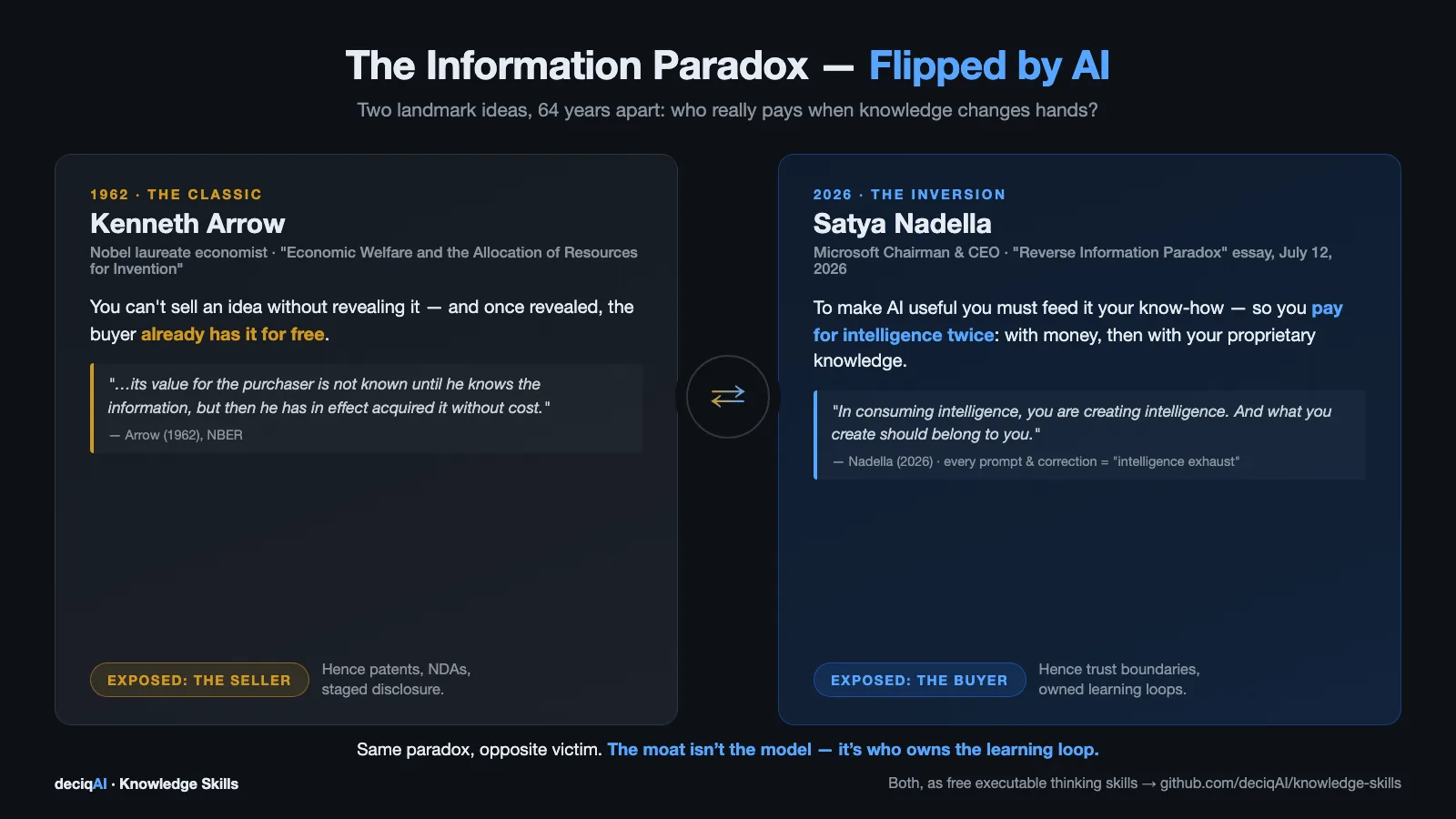
Satya Nadella's Reverse Information Paradox (July 2026): enterprises pay for AI twice — once with money, and again with the proprietary knowledge they must reveal to make it useful. It inverts Kenneth Arrow's 1962 information paradox, where the exposed party was the seller. The defense is a trust boundary: own your data, evals, memory, and learning loop.
In 1962, economist Kenneth Arrow described a trap that shaped sixty years of dealmaking: you can't sell an idea without revealing it — and once revealed, the buyer already has it for free. Patents, NDAs, and staged disclosure all exist because of it. The exposed party was always the seller. On July 12, 2026, Satya Nadella flipped it.
“…its value for the purchaser is not known until he knows the information, but then he has in effect acquired it without cost.”
The inversion: now the buyer is exposed
Nadella's Reverse Information Paradox says the AI era reverses who gets trapped. To make an external model useful, you must feed it your proprietary knowledge — your workflows, your judgment calls, your corrections. In his words, enterprises "essentially pay for intelligence twice… once with money, and again with something even more valuable: the proprietary knowledge you must reveal to make that intelligence useful."
He calls the leak intelligence exhaust: every prompt, tool call, correction, and eval is a record of how your organization works and decides — flowing, trace by trace, toward whoever controls the learning infrastructure. The better you want the model to perform, the more of your edge you hand over.
The defense: a trust boundary
- Own the learning loop: your data, your evals, your memory, your adapted model weights stay inside your boundary.
- Decouple the orchestration layer from any single model — portability is leverage.
- Before any AI renewal, ask the vendor one question: when my team corrects your model, who keeps the learning?
“In consuming intelligence, you are creating intelligence. And what you create should belong to you.”
Why founders should care
The moat isn't the model — it's who owns the learning loop. If your corrections make a vendor's model smarter for your competitors, you're funding their moat with your know-how. Same paradox, opposite victim: Arrow's seller needed disclosure discipline; the AI buyer needs boundary discipline.
We turned both into free, executable thinking skills — Arrow's original with its disclosure playbook (patent vs. secret, staged reveals, trusted intermediaries), and Nadella's inversion with a trust-boundary audit you can run on your own AI stack before the next contract.
FAQ
What is the Reverse Information Paradox?
A concept Satya Nadella introduced in July 2026: to make external AI useful, enterprises must reveal proprietary knowledge — so they pay twice, once with money and again with know-how. It inverts Arrow's classic paradox, where the exposed party was the information seller, not the buyer.
What is Arrow's information paradox?
Kenneth Arrow's 1962 observation that information can't be valued without being revealed, and once revealed the buyer has effectively acquired it for free. It's the economic reason patents, NDAs, staged disclosure, and trusted intermediaries exist.
What is intelligence exhaust?
Nadella's term for the stream of prompts, corrections, and evaluations an organization generates while using AI — a record of how it works and decides, which leaks toward whoever controls the learning infrastructure unless a trust boundary stops it.
How do I protect my company from the Reverse Information Paradox?
Draw a trust boundary: keep your data, eval sets, memory, and adapted model weights under your ownership; decouple your orchestration layer from any single model provider; and make 'who keeps the learning from our corrections?' a standard question in every AI vendor negotiation.